By Kobi Lahav · StreetCred · November 2026 · 13 min read
Ten companies now run your retirement account. One man runs the biggest of them. When he stumbled, $600 billion left the room before lunch. Real estate has never looked so boring, or so smart.
Your index fund is not a diversified portfolio. It is a concentrated bet on ten companies that lend to, buy from and invest in each other. The investor who can't see that is carrying risk he was told he had sold.
Let's start with an observation most financial advisors would rather not say out loud: the stock market is no longer a market of stocks. It is a handful of balance sheets wearing a 500-company costume.
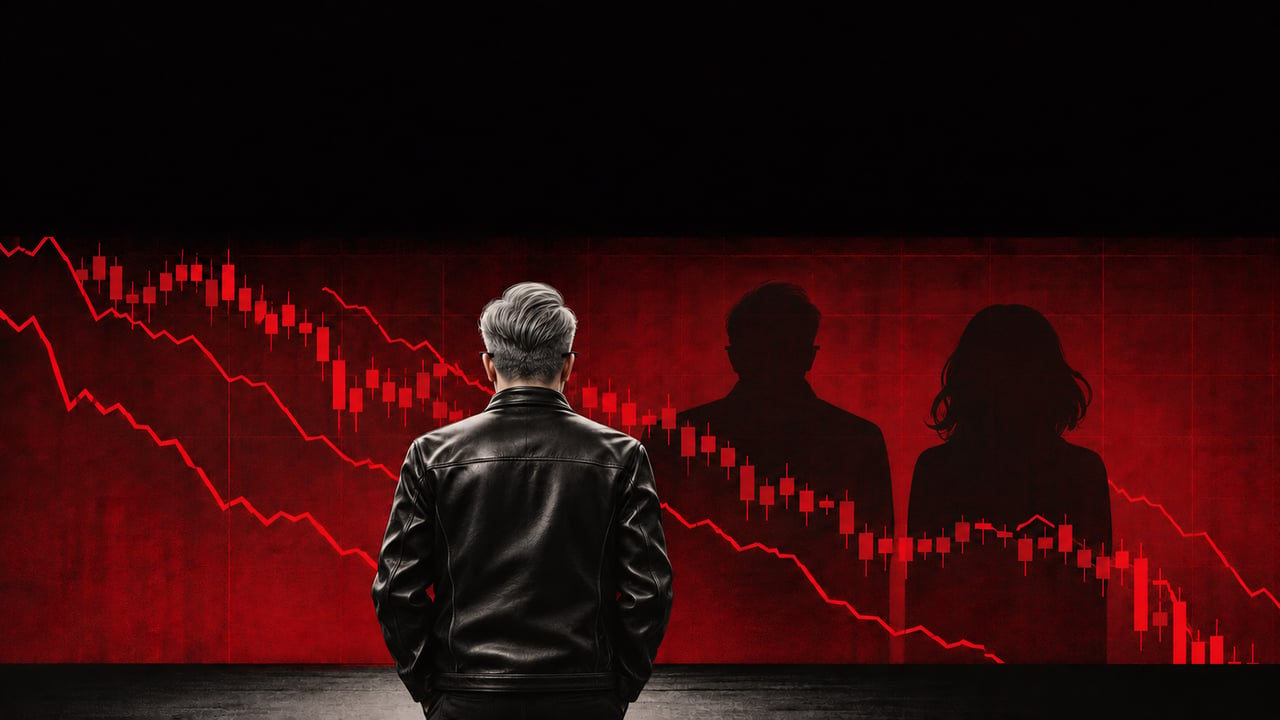
On November 12, Nvidia's board announced that Jensen Huang had resigned. The trigger was a report of relationships with two women, one of them allegedly a Chinese spy (CNN). The stock fell as much as 14% that morning, about $600 billion, and closed down 4.3% (Statista). From its October 6 record, Nvidia had lost 31% and almost $1.8 trillion.
Not all of that was the scandal. The slide began with doubts about AI spending and rising rates. But nervous markets are where one headline does the most damage, and this headline had nothing to do with chips.
Eleven days later the board brought him back, and the stock closed up 31% in a single session (CNBC). Same chips. Same customers. A swing larger than the GDP of most countries, priced off one man's private life.
I sell real estate for a living, so discount what follows accordingly. Then check my math.
"A stock is priced every second. A building is priced when someone signs. Only one of those can lose $600 billion before lunch."
I · THE FRAMEWORK
Three fault lines under your brokerage account
Volatility is not random. It travels through structure. The modern stock market has three structural fault lines, and the Nvidia episode ran through all three at once.
01 — Concentration
An index weights companies by size. The bigger a stock gets, the more of it your fund has to buy, which makes it bigger. At the end of September, Nvidia was 8.3% of the S&P 500 and the ten largest names were nearly 40% (Tema ETFs, citing BlackRock holdings). You did not choose that bet. The index chose it for you.
02 — Key-man risk
When one company is 8% of the market, its CEO is a macro variable. His health, his judgment and his personal life now sit in the same category as the Fed and the price of oil. No apartment building has a CEO.
03 — Circular money
The companies at the top finance each other. The supplier invests in the customer. The customer borrows against the supplier's product. The lender owns stock in both. It works until one of them has a problem. Then they all have the same problem on the same day.
These three compound. Concentration makes the key man matter. Circular money makes sure his problem spreads. And a more connected world moves the shock faster every year.
II · THE CASE FILES
Eight files. Three fault lines. One control group.
Let's move from framework to evidence. Seven case files show how the fault lines break. The eighth shows what it looks like when they are not there.
CASE FILE 01 · SANTA CLARA · OCTOBER–NOVEMBER 2026
Nvidia: The Key-Man Crash ↓ SIGNAL: FRAGILE
Read the sequence slowly. October 6: a record close of $239.24. November 5: with no announcement from the company, the stock falls 9.3% and the S&P 500 falls 4.4% in a single session (Trefis). November 12: the CEO resigns and the stock drops 14% before lunch. November 23: he is reinstated and it gains 31% by the close.
Seven weeks. Down 31%, then up 31%. Here is the arithmetic nobody advertises: lose 31%, gain 31%, and you are still down almost 10%. A 31% loss needs a 45% gain to get back to even. Volatility is not a round trip. It is a toll road.
THE READ: This was the largest company in the S&P 500, not a meme stock. If its price can swing by a third on a personnel matter, "blue chip" no longer means what your advisor thinks it means.
CASE FILE 02 · YOUR BROKERAGE ACCOUNT
The $1,000,000 Index Fund: What You Actually Own ↓ SIGNAL: CONCENTRATED
Put $1,000,000 into an S&P 500 fund and open the hood.
Your $1,000,000 index fund | Amount |
|---|---|
In Nvidia (8.3%) | $83,000 |
In the ten largest companies (about 40%) | $400,000 |
In the other 490 | $600,000 |
Lost when Nvidia alone falls 31% | about $26,000 |
That $26,000 is one stock's bad stretch, before the rest of the index reacts. And the rest reacts. On November 5 the whole index fell 4.4%. On your $1,000,000, that is $44,000 gone between breakfast and dinner, on a day when nothing happened.
THE READ: You bought 500 companies for safety. You got ten for risk and 490 for decoration.
CASE FILE 03 · THE AI SUPPLY CHAIN
The Circle: Everyone Owes Everyone ⚠ SIGNAL: STRUCTURAL
Jensen is the headline. The structure underneath is the real risk.
- Nvidia agreed to invest up to $100 billion in OpenAI, which spends heavily on Nvidia chips (Morningstar).
- CoreWeave borrowed against Nvidia GPUs as collateral. Nvidia owns CoreWeave stock and agreed to take its unused capacity (same Morningstar piece).
- Five big tech companies account for more than 40% of Nvidia's revenue (Axios).
Axios described the arrangement this summer: you buy from me, I invest in you, and it works until one of us has a problem. Then we both do (Axios). When Nvidia shed its first trillion this fall, Reuters pointed to rising rates and heavy debt across technology companies (Wealth Professional).
THE READ: A supplier, a lender and a customer used to be three separate risks. Today they are one balance sheet seen from three sides, and all three sit in your index fund.
CASE FILE 04 · HANGZHOU TO WALL STREET · JANUARY 27, 2025
DeepSeek: The Startup Nobody Had Modeled ↓ SIGNAL: CONTAGIOUS
A Chinese AI lab most American investors had never heard of released a cheaper model. By the close, Nvidia had fallen 17% and lost close to $600 billion, at the time the largest one-day loss for any company in U.S. history (NBC New York). Broadcom fell 17% the same day and lost another $200 billion.
Nvidia had not issued a warning, lost a customer or missed a number. A product launch on the other side of the world repriced it. And note whose record it broke. The previous one, $279 billion, had been set by Nvidia itself the September before.
THE READ: When the largest stock in the index can be repriced by a competitor's launch on another continent, you do not own a company. You own a position in a global argument.
CASE FILE 05 · TOKYO · AUGUST 5, 2024
The Carry Trade: A Rate Hike in Japan, a Margin Call in New York ↓ SIGNAL: INTERCONNECTED
The Bank of Japan raised rates by a fraction of a point. Three trading days later the Nikkei fell 12.4%, its worst day since Black Monday in 1987 (Fox Business). Korea's Kospi fell 8.8% and TSMC nearly 10% (Business Insider). Before New York opened, Nvidia was down 9% and Apple 8%.
Why would a rate decision in Tokyo hit Cupertino? Because investors had borrowed cheap yen to buy other assets, chiefly U.S. tech stocks (BNN Bloomberg). When the yen jumped, the loans had to be repaid, and the stocks were what got sold. Axios noted at the time that the unwind exposed the risk of concentration in Big Tech (Axios).
THE READ: A lease has no funding leg in Tokyo. An asset financed locally answers to local conditions. An asset financed by the whole world answers to all of it at once.
CASE FILE 06 · ABILENE, TEXAS · 2026
Oracle: The Debt Behind the Boom ⚠ SIGNAL: LEVERAGED
The AI buildout is increasingly paid for with borrowed money, and Oracle is where it shows. Its long-term debt reached roughly $124.7 billion, up from about $85 billion a year earlier, and the cost of insuring that debt hit a record (Yahoo Finance). More than $300 billion of its $553 billion contracted backlog is owed by a single customer, OpenAI, which is reportedly losing billions (Fast Company, via Inc.).
In September, Oracle tried to put off lease payments on a delayed data center. Its stock was down 30% for the year, and spreads on bonds financing data centers where Oracle is the tenant briefly blew out (Axios). Oracle is not alone in the structure. Meta financed a Louisiana data center through a $27 billion joint venture whose debt sits in a special-purpose vehicle, off Meta's balance sheet (MarketWatch, via Morningstar).
THE READ: Students of 2008 will recognize the vocabulary: credit default swaps, special-purpose vehicles, one counterparty everybody depends on. Different asset. Same plumbing.
CASE FILE 07 · MURRAY HILL, NEW JERSEY · 2000
Lucent: We Have Seen This Movie Before ↓ SIGNAL: PRECEDENT
At the top of the dot-com boom, Lucent was the country's leading maker of telecom equipment, and it lent its customers the money to buy that equipment. The loan book reached $8.1 billion, much of it to startups that later folded or filed for bankruptcy (Treasury & Risk).
One of them was Winstar. Lucent gave it a $2 billion financing deal. Winstar went into Chapter 11 and sued Lucent for $10 billion (eWeek). The revenue had been real only as long as the loans were. Lucent's stock, once among the most widely held in America, traded below a dollar by 2002.
THE READ: A supplier financing its customers looks like growth on the way up and like a hole on the way down. Reread Case File 03 and decide how different it is.
CASE FILE 08 · MANHATTAN · THE SAME EIGHTEEN MONTHS
The Control Group → NYC SIGNAL: BORING
Now run the same period through an asset with no ticker. In April 2025, a tariff announcement took $5 trillion off the S&P 500 in two days, a record, and the index fell about 10.5% (Reuters, via The Express Tribune). On a $1,000,000 account, that is $105,000 in forty-eight hours. Days later the index jumped 9.5% in one session when the tariffs were paused (PBS).
Here is what the median Manhattan co-op and condo did across that stretch.
Quarter | Manhattan median sale price |
|---|---|
Q2 2025 (the tariff crash) | $1,200,000 |
Q3 2025 | $1,180,000 |
Q4 2025 | $1,125,000 |
Q2 2026 | $1,250,000 |
Q3 2026 | $1,250,000 |
Sources: Elliman Report for Q2 and Q3 2025 and Q4 2025; Brick Underground for 2026.
From the low to the high of those five quarters is 11%. The S&P 500 covered that distance in two days. One caveat, stated plainly: the fourth-quarter numbers, which will include the Nvidia weeks, are not out yet, and a median hides the individual deals that went badly.
NYC READ: Manhattan took five quarters to travel as far as the stock market moved in forty-eight hours. That is not a lack of return. It is a lack of drama, and drama is what you are paying for on Wall Street.
ONE STOCK'S SHARE OF THE S&P 500 | ONE MORNING, ONE RESIGNATION | THE DISCOUNT THAT CANCELS A RATE HIKE |
|---|---|---|
8.3% | $600B | 10% |
Nvidia's weight in the index | Erased from Nvidia before lunch | Off the price offsets a one-point rise in mortgage rates |
III · THE SYNTHESIS
What this means for where you put the next dollar
Let's stop being abstract. Stocks are liquid, cheap to own and have returned roughly 10% a year for a century. Nobody serious tells you to sell them all. The claim here is narrower: the calm part of your net worth should not sit on the same fault lines as the exciting part.
Real estate is slow. That is the product. Nobody reprices your building at 9:30 a.m. because a CEO in California made a bad decision. Its value comes from a lease, a location and local supply. Rent arrives on the first whether or not the Nasdaq opens. And you have a kind of control no shareholder has. You cannot call Nvidia's board. You can inspect a property, negotiate its price, renovate the kitchen, raise the rent and refinance the loan.
The objection is always rates. The 30-year fixed averaged 7.28% on November 19, up from 6.26% a year earlier (Freddie Mac). Here is what the rate-watchers miss: high rates are what make sellers negotiable, and price beats rate.
Take a $1,000,000 apartment, 20% down, 30-year loan.
Full price, last year's rate | Full price, today's rate | 10% off, today's rate | |
|---|---|---|---|
Purchase price | $1,000,000 | $1,000,000 | $900,000 |
Down payment | $200,000 | $200,000 | $180,000 |
Loan | $800,000 | $800,000 | $720,000 |
Rate | 6.26% | 7.28% | 7.28% |
Monthly principal and interest | $4,931 | $5,474 | $4,926 |
A 10% discount erases the entire one-point jump in rates. You pay the same monthly as last year's buyer and keep $20,000 of your down payment.
Now the part buyers miss. You can refinance a rate. You cannot refinance a purchase price. If rates return to 6.26%, the buyer who negotiated refinances to $4,438 a month. That is $493 less than the buyer who paid full price in the cheap-money year, every month, for the life of the loan. Refinancing costs money and nobody can promise lower rates. The discount is yours either way.
The same math runs the investor's side. A unit earning $60,000 a year in net income yields 6.0% at $1,000,000, below the cost of the debt. At $800,000 it yields 7.5%, above it. Same unit. Same tenant. The purchase price decided whether the deal works.
Getting 10% off is work. The median Manhattan listing discount is 3.8% (Brown Harris Stevens). The rest comes from stale listings, motivated sellers and clean terms. That is not luck. That is the job.
THE STREETCRED THESIS, DISTILLED
Connection is a transmission line for volatility, and securities sit directly on the line. Every year the world gets more connected: more index money, more cross-holdings, more companies financing their own customers. Every year the shocks travel faster.
The investor who reads the S&P 500 as diversification is holding ten correlated bets and calling it safety. The investor who understands concentration, key-man risk and circular money moves part of his capital into an asset he can inspect, negotiate and control. And as prices soften, the rate stops being the threat. The price you negotiate is the return.
Fast money is priced every second. Slow money is priced when you sign. Buy accordingly.
"You can refinance a rate. You cannot refinance a price."
IV · HISTORICAL POSTSCRIPT
This is not new. It has always worked this way.
For the skeptic who thinks this time is different, consider the record. At the dot-com peak, the ten largest stocks were 27% of the S&P 500 (Interactive Brokers, citing Goldman Sachs). Today they are nearly 40%. Technology companies were financing their own customers then too, and it made the damage worse when the bubble popped (Fortune). The Nasdaq fell about 78% from its 2000 peak and needed fifteen years to see that level again.
And yes, 2008. Real estate people do not get to skip it. Home prices fell hard, and owners with too much leverage were wiped out. But look at what turned a housing correction into a global crisis: mortgages sliced into securities, sold around the world and wired into every bank's balance sheet. The buildings stood. The paper failed. Interconnection was the weapon then too.
The pattern does not change. Concentration, cross-financing, one trigger. In 2000 the trigger was earnings. In 2008 it was mortgages. In 2026 it was a CEO's private life. The next one will be something nobody has modeled, and it will travel through the same pipes.
Own something that doesn't have a CEO.
This post is commentary, not investment advice. Payment figures are principal and interest only, rounded to the nearest dollar.